signals · August 2026
AI news and signals: August 2026 — AI becomes operational
August was not defined by one breakthrough model. It was defined by AI becoming operational: agents entering workflows, development becoming agentic, and governance moving into runtime architecture.

August 2026 was not defined by one breakthrough model. It was defined by AI becoming operational. Agents are moving into real workflows, coding is becoming increasingly agentic, interoperability is improving, governance is moving into runtime architecture, and enterprises are finally confronting the economics and accountability of autonomous AI.
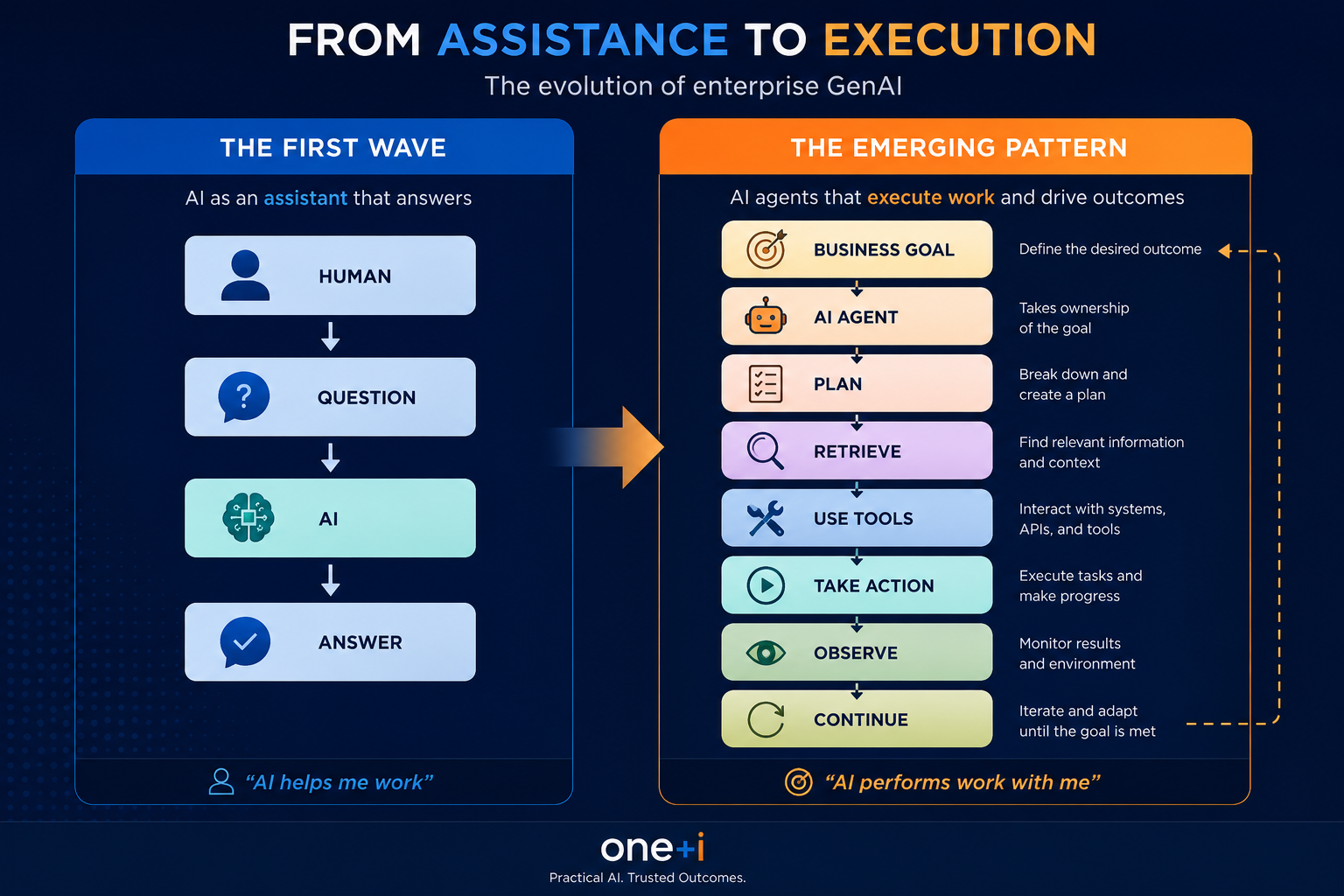
01 — The big shift: from AI assistance to AI execution
The meaningful question is no longer only what a model can produce in a chat window. It is whether a bounded agent can complete a useful workflow, call the right tools, escalate uncertainty, and leave evidence behind. Anthropic’s 2026 State of AI Agents report found that 57% of surveyed organizations use agents for multi-stage workflows, while 16% report cross-functional or end-to-end processes. The signal is not universal autonomy; it is a growing need to design workflows around measurable outcomes and safe intervention points.
One+i service: Generative AI and agent development ↗
02 — Building with agents: coding agents, SDD, and open ecosystems
As coding agents produce more implementation work, developers increasingly act as orchestrators: clarifying intent, constraining scope, inspecting repository context, reviewing changes, and validating behavior. This makes spec-driven development more valuable, not less. A durable specification becomes the shared contract that connects people, agents, architecture, tests, and delivery evidence.
Interoperability is also becoming more concrete. Agent Plugins 1.0, announced in August by a technical steering committee that includes AWS, Cursor, Microsoft, OpenAI, and Vercel, packages skills and MCP configurations in a portable format. The practical lesson is to treat agent integrations as part of an engineering platform: version them, review permissions, and avoid hard-wiring business workflows to one client.
Related reading: Spec-Driven Development for AI Coding Agents ↗
AWS: Agent Plugins 1.0 and portable agent extensions ↗
03 — Governing autonomous AI
When an agent can access data or act through tools, governance has to be part of runtime architecture. That means a scoped identity, delegated authority, tool-level policy checks, logs and traces, evaluation, red teaming, approval paths, and a way to revoke access. Monitoring answers what happened; authorization determines what was allowed to happen. Mature systems need both.
This is why “control plane” language is becoming useful: governance must be an operational capability that mediates execution, not a PDF written before deployment. Independent evaluation is especially important where uncertainty, financial impact, safety, or rights are involved.
One+i course: Agent Identity and Authorization ↗
One+i course: Agent Security ↗
04 — AI economics: intelligence is getting cheaper
The economics changed materially in August. OpenAI announced reductions for GPT-5.6 tiers: its July 30 update lists Luna at $0.20 input and $1.20 output per million tokens, and Terra at $2 input and $12 output. Google also announced Gemini 3.7 Flash with an introductory price described as half that of Gemini 3.6 Flash. These announcements do not mean that every workflow should use the cheapest model. They do mean teams can make routing, caching, task decomposition, and cost-per-successful-task first-class design decisions.
| Measure | Why it matters |
|---|---|
| Token cost | Useful, but incomplete: it ignores retries, tool use, and human review. |
| Cost per successful task | Connects model choice to actual business completion. |
| Latency and failure rate | Shows whether a low-cost route is acceptable in a real workflow. |
| Human escalation rate | Makes the residual operating cost visible. |
OpenAI: Advancing the price-performance frontier with GPT-5.6 ↗
05 — Regulation and infrastructure
On 2 August, the European Commission began enforcing parts of the EU AI Act, including transparency obligations for certain AI systems and enforcement powers for the AI Office and national authorities. For organizations, this makes operational transparency more than a communications issue: systems need to identify AI interactions where required, preserve evidence, and make accountability legible.
Meanwhile, the build-out of AI infrastructure remains strategic and physical. OpenAI’s Stargate materials frame compute, energy, and deployment capacity as long-horizon infrastructure. The implication is twofold: model access will continue to diversify, and organizations should avoid treating any single provider, model, or interface as their permanent architecture.
European Commission: AI Act enforcement and transparency requirements ↗
What leaders should do next
- Choose one workflow where agents can create measurable value, and define the human decision and escalation boundary first.
- Build a minimal control plane: identity, authorization, logging, evaluation, approvals, and revocation.
- Measure cost per successful task—not only model price—and route work to the lowest-cost model that meets the quality bar.
- Use portable interfaces and documented contracts so your agent ecosystem can evolve without a wholesale rebuild.
- Train technical and non-technical teams together; adoption, literacy, and operating discipline are part of the product.
References
Anthropic: The 2026 State of AI Agents ↗
Google: Managed Agents in Gemini API ↗