GenAI & LLMs · August 2026
Building AI agents: from loops to teams
A practical map for understanding, designing, evaluating, and operating AI agents and agentic workflows—from the first tool call to multi-agent production systems.
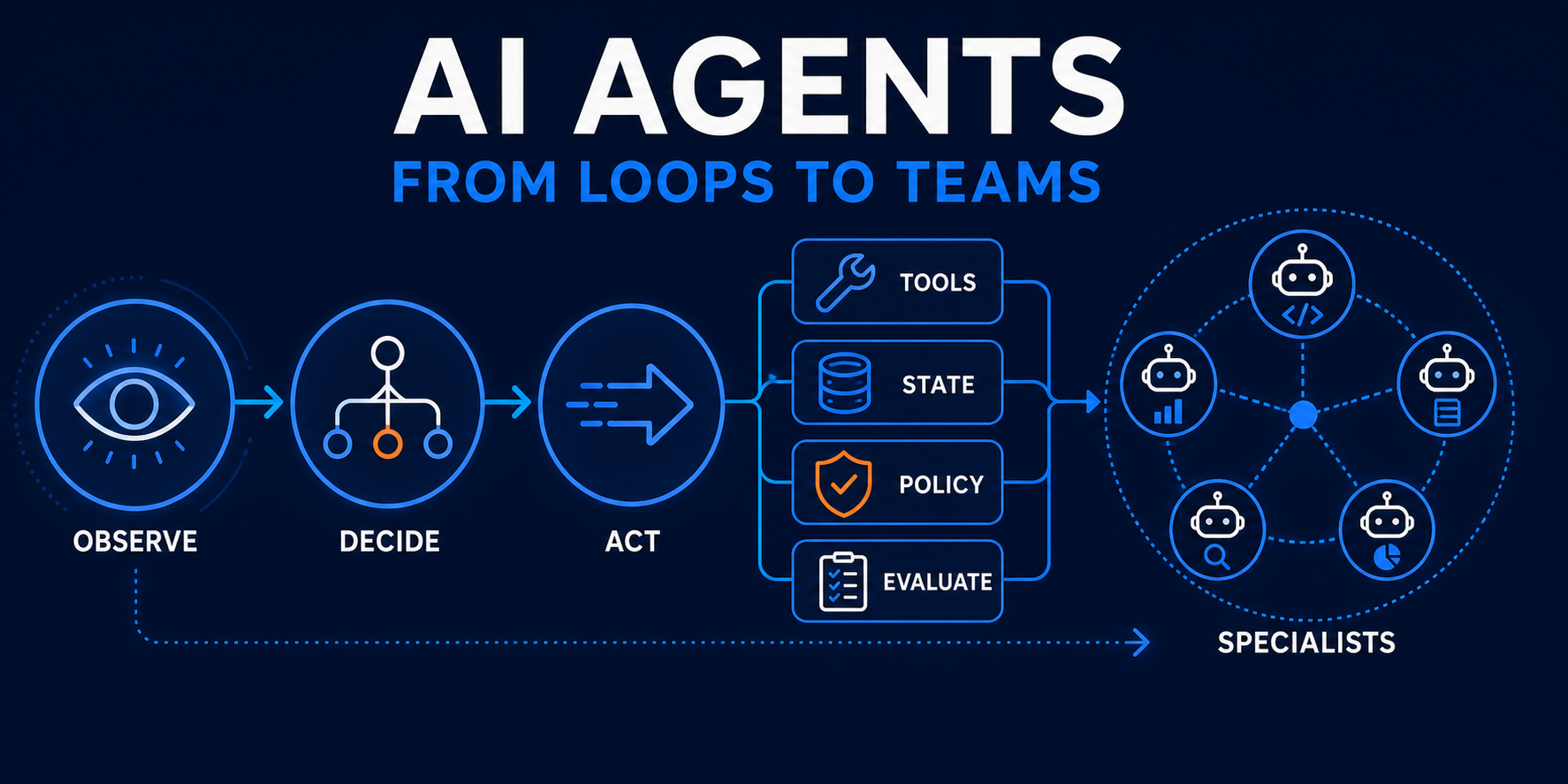
AI agents are moving from intriguing demonstrations into research, support, coding, analysis, and operations. But an agent is more than a language model with a prompt. It combines a model with instructions, tools, state or memory, and a control loop that lets it observe results and decide what to do next. The engineering challenge is to make that flexibility useful without making behavior impossible to understand or control.
The Awesome AI Agents repository is a curated, practical guide for learning those foundations and making informed design choices. It brings together a structured Learning Hub, runnable labs, notebooks, implementation references, architecture patterns, evaluation guidance, and a full knowledge check.
First understand the agent loop
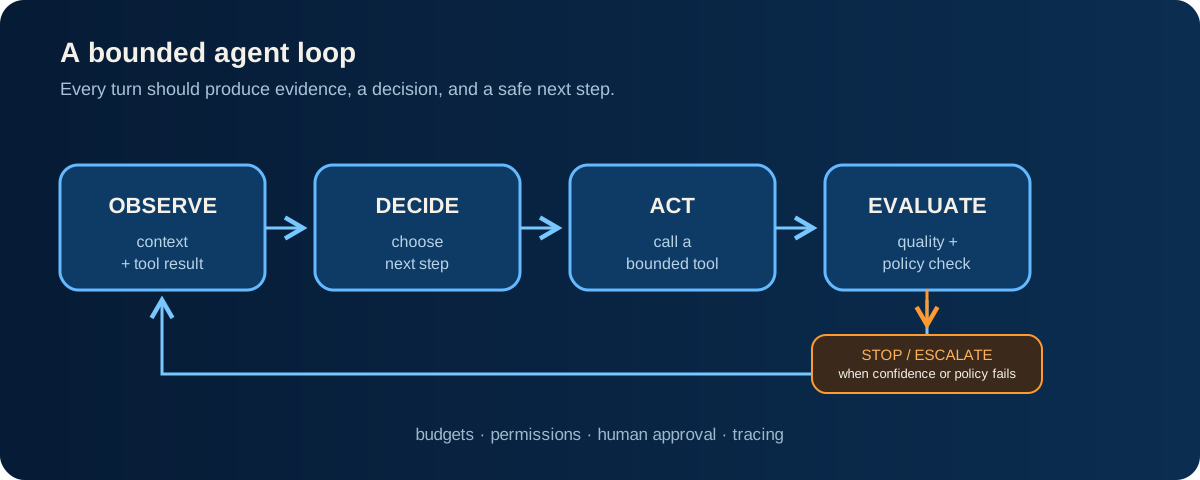
A useful mental model is observe → decide → act. The agent receives a goal and context, chooses whether to answer or call a tool, observes the result, and continues until it reaches a success condition, a safe stopping point, a budget limit, or a human escalation. Production systems add policy checks, tracing, evaluation, and explicit handling for uncertainty and failure.
The building blocks of an agent
The repository organizes the core components into model, instructions, tools, state and memory, control loop, guardrails and permissions, and evaluation and tracing. Each component creates a design decision: which context is authoritative, which operations are typed and validated, what state can persist, who owns an action, and how the team will know whether the task was actually completed.
Agent or workflow? Choose the least autonomy that works
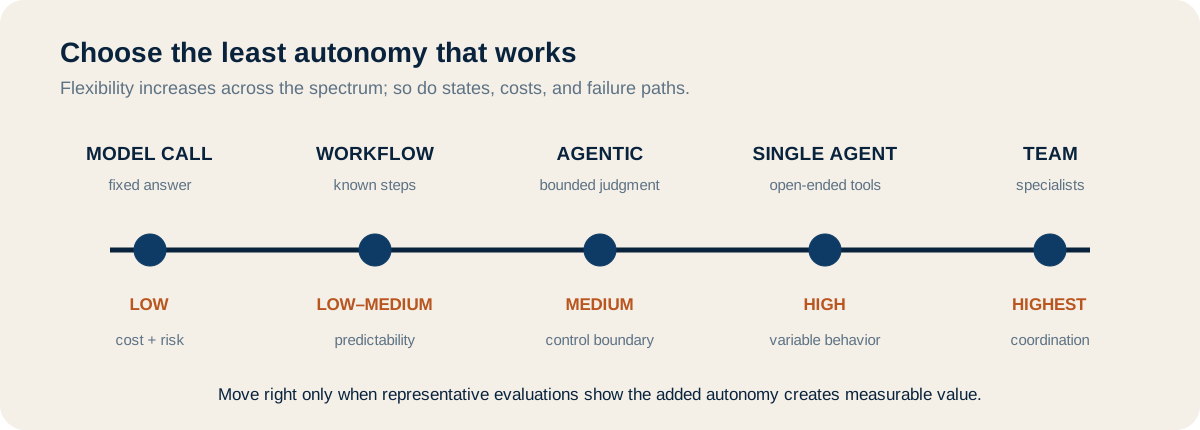
A deterministic workflow is often the right starting point when the steps are known. An agentic workflow is useful when a few decisions require model judgment but the overall path can remain bounded. A single agent fits open-ended tool use; a multi-agent system may help when work separates naturally into roles or contexts. More autonomy also means more states, costs, failure paths, and evaluation work. The repository recommends justifying additional autonomy with representative evidence rather than demo appeal.
A progression from beginner to advanced
The Learning Hub follows three levels. Beginner lessons cover the agent loop, tool contracts, state, memory, safe stopping, and a research-assistant capstone. Intermediate work compares workflows and agents, introduces architecture patterns, and adds evaluation and support-workflow gates. Advanced material covers multi-agent teams, durable recovery, protocol boundaries, safety readiness, and a research-team capstone.
Build with small, testable tools
A tool is a privileged interface, not merely a function the model can discover. Good tools have narrow responsibilities, typed schemas, unambiguous names, useful errors, idempotency where possible, and explicit risk metadata. Start with deterministic stubs and read-only operations. Add provider integrations, writes, and external side effects only after policy and evaluation tests are in place.
Memory and state need ownership
Separate working state for the current run from long-term memory that can influence future tasks. Long-term writes should be scoped to an identity or tenant, validated before storage, auditable, and reversible. This is both a reliability and privacy requirement: stale, incorrect, or cross-tenant memory can quietly change future behavior.
Architecture patterns that make trade-offs visible
The repository compares prompt chaining, routing, parallelization, orchestrator-worker, evaluator-optimizer, ReAct loops, and human approval. Each pattern has a control boundary and a failure mode. Prompt chaining can make fixed sequences legible; routing can select a specialist; parallelization can improve coverage; orchestrator-worker can decompose unknown work; evaluator-optimizer can refine outputs; and human approval can protect high-impact actions.
Multi-agent systems: coordination is the product
Multi-agent design is not automatically better. Teams need clear ownership, context boundaries, communication contracts, termination conditions, and a reason to split the work. Compare the team against a simpler single-agent baseline. Otherwise, coordination overhead and compounded failures can outweigh the benefits of parallelism or specialization.
Evaluate outcomes, trajectories, and operations
Agent evaluation should cover more than a final answer. Measure outcome quality and policy compliance; inspect the trajectory, including tool choice, arguments, planning, grounding, recovery, and unnecessary steps; and monitor the operational envelope: latency, cost, loop length, failure rate, escalations, and side effects. The repository points learners toward task suites, graders, traces, and regression tests that resemble their actual workload.
Production safety is a release discipline
Before release, define success and stop conditions, time and spend limits, least-privilege credentials, validation at trust boundaries, human approval for destructive or sensitive actions, isolated execution, immutable audit records, tenant-scoped memory, idempotent writes, adversarial tests, and a kill switch. Treat user input, retrieved content, web pages, tool output, and messages from other agents as untrusted.
Use the course as a build-and-review loop
The Hub is designed around Learn → Design → Check. Read the concept and its sources, inspect the practical guide, run a lab or notebook, conduct a design review, and then test judgment with the quiz. This approach helps teams turn agent enthusiasm into shared vocabulary, explicit trade-offs, and repeatable engineering practice.
Explore the Awesome AI Agents repository ↗
Open the AI Agents Learning Hub ↗
Take the 18-question AI Agents Knowledge Check ↗
OpenAI: A practical guide to building AI agents ↗
Anthropic: Building effective agents ↗
ReAct: Synergizing reasoning and acting in language models ↗