GenAI & LLMs · July 2026
Evaluating RAG systems beyond the demo
A practical look at retrieval quality, grounded answers, citations, and the measurements that matter.
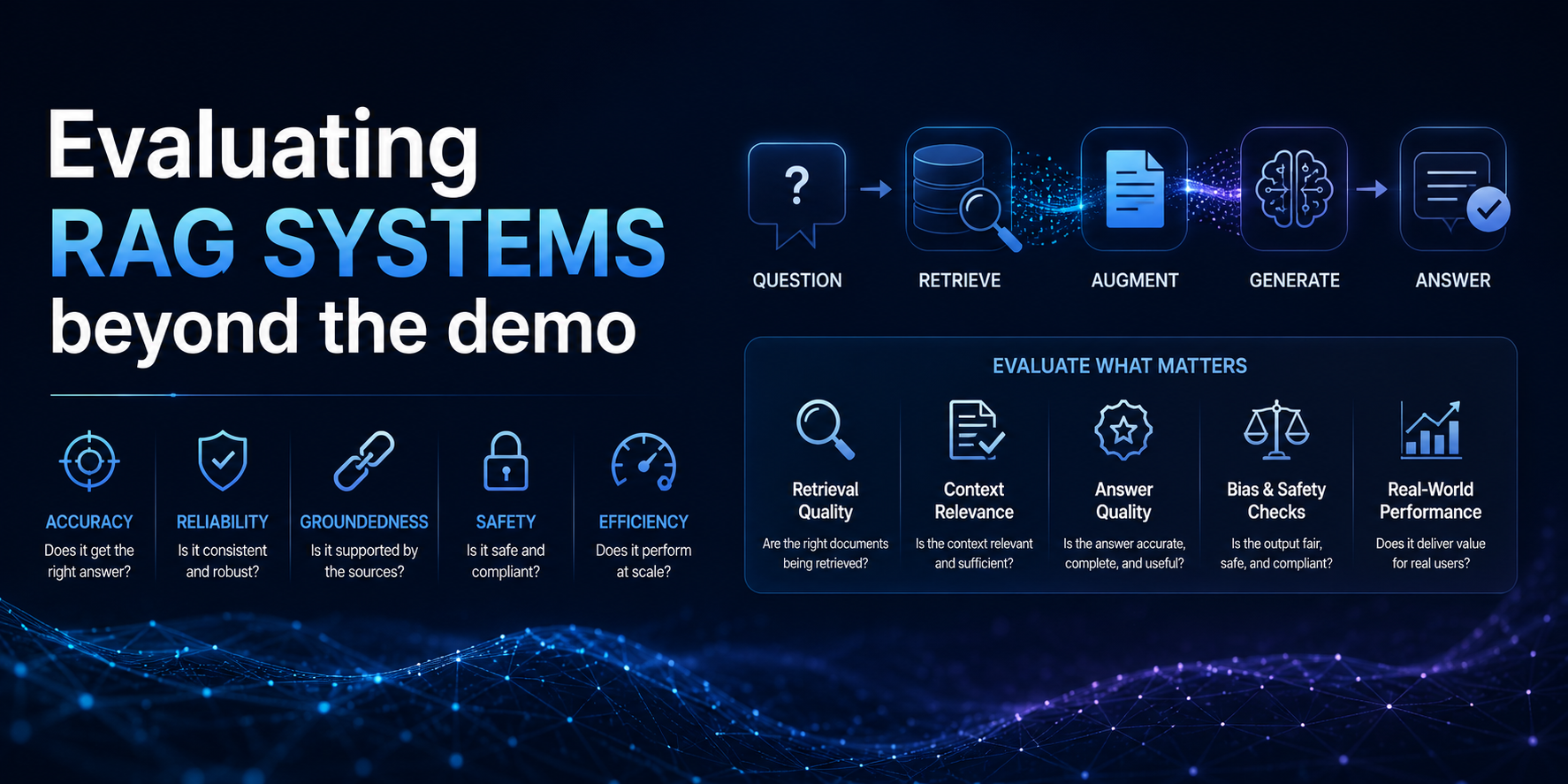
A RAG system can produce a convincing answer while retrieving weak evidence or quietly inventing unsupported details. Evaluation needs to separate retrieval quality from generation quality.
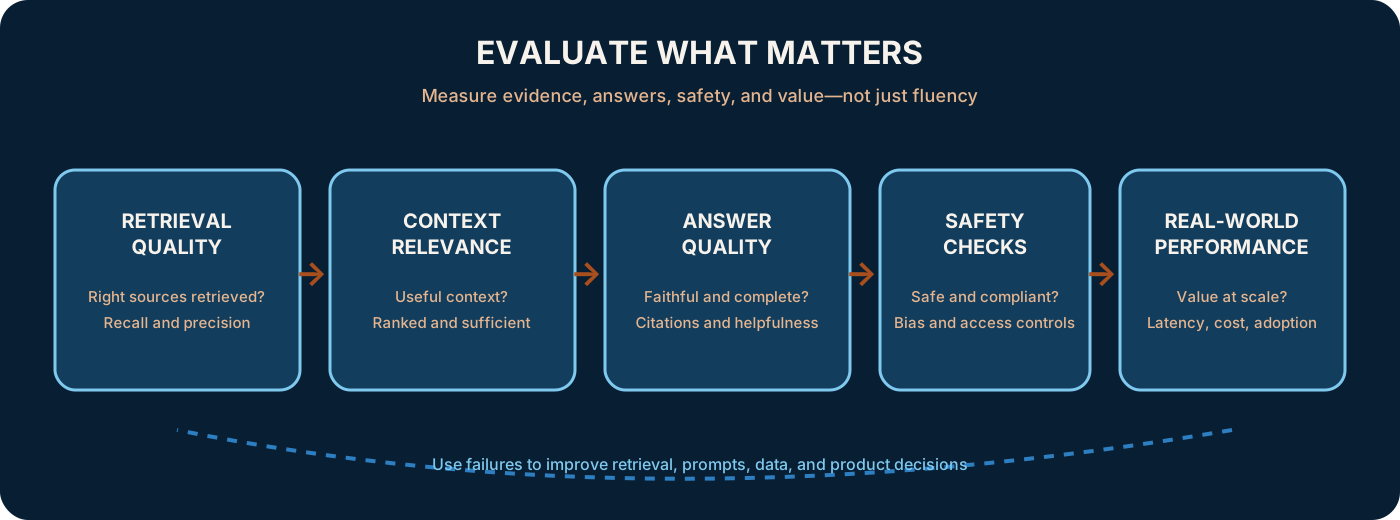
Start with a representative evaluation set that includes fresh, stale, adversarial, permission-boundary, and no-answer questions. Track context recall and precision alongside answer faithfulness, citation coverage, latency, and cost.
Build an evaluation set that resembles reality
A small collection of easy questions can make a weak system look excellent. Include the questions users actually ask, paraphrases, long-tail requests, ambiguous prompts, unanswerable questions, stale knowledge, and access-controlled content. Label expected sources, acceptable answers, and when the correct behaviour is to abstain.
Separate retrieval from generation
If the right evidence never reaches the model, changing the prompt will not solve the problem. Measure retrieval recall, precision, ranking quality, chunk usefulness, and permission filtering separately from answer faithfulness, completeness, citation accuracy, and helpfulness.
Measure the system in operation
Offline scores are only one checkpoint. Monitor latency, cost, empty retrieval, citation coverage, user correction, escalation, and drift after launch. Review failures with both technical and domain experts so metrics remain connected to the decisions the system supports.
The goal is not a single score. It is a repeatable feedback loop that shows where the system fails, whether an improvement actually helps users, and when the system should decline to answer.
Explore the RAG evaluation material ↗
RAGAS: Automated evaluation of retrieval augmented generation ↗